Skip to main navigation menu Skip to main content Skip to site footer

##common.pageHeaderLogo.altText##

Current Issue

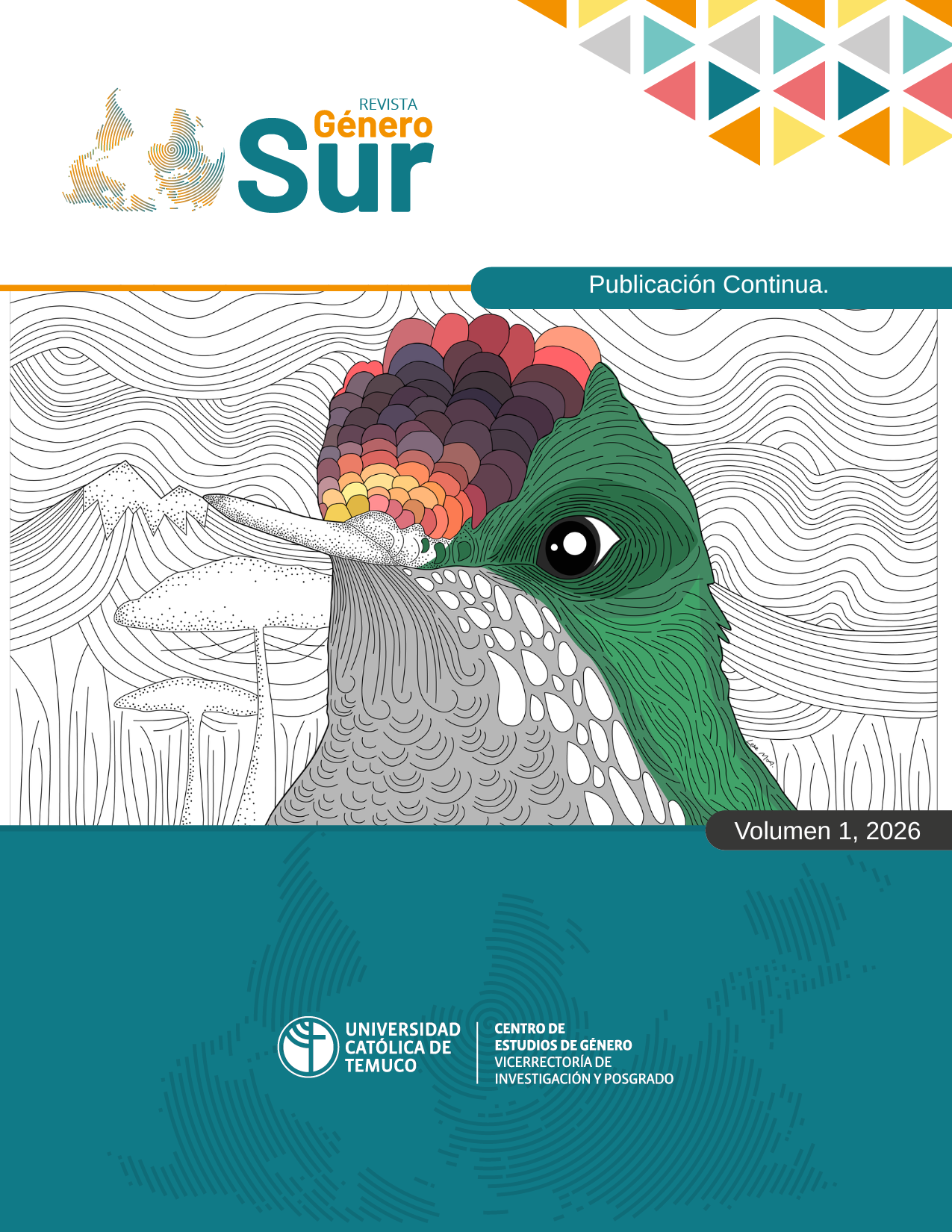
Volume 1, No. 1Publicación Continua

Published January 1, 2026

Issue description

Con gran satisfacción presentamos el primer número de la Revista Género SUR, iniciativa del Centro de Estudios de Género de la Universidad Católica de Temuco. Este proyecto busca abrir un espacio de reflexión crítica e interdisciplinaria sobre género, territor ... See the full issue

Artículos

  1. Space Invaders in Engineering: Gender, Body, Epistemic Experience, and Belonging among Engineering Students in Chile

    Gender studies in engineering have gained significant momentum in recent decades, particularly those examining disciplinary culture. However, much remains to be explored regarding embodied and spatial perspectives. This article contributes to understanding the relationship between embodied experience, knowledge experience, and the sense of belonging among women and other feminized bodies in engineering. Drawing on empirical data from 15 focus groups conducted across five universities in three cities in Chile, and using an inductive qualitative approach, we show how the masculine somatic norm on engineering campuses continues to shape who is heard within the field of knowledge. This norm constrains the recognition of “bodies perceived as out of place” as legitimate bearers of knowledge. Our findings highlight the complex interplay between gender, body, and knowledge within engineering student communities.
  2. Women's Voices: the sounds of violence against women and their possible psycho- social impacts

    Sound violence can manifest through intense sounds, distorted timbres, and accelerated rhythms, which may provoke negative behaviors and effects in those who hear them. Prolonged exposure to these harmful sonic experiences can lead to feelings such as depression, anxiety, sadness, humiliation, and other indelible psychosocial consequences. From this perspective, the discussion aims to provoke reflection on negative soundscapes through three au- diovisual works: the film Sound of Violence by Alex Noyer (2021), the short film O Buraco by Zeudi Souza (2022), and the series She’s Gotta Have It by Spike Lee (2017). Using a qualitative film analysis methodology, the categories of social space, constraint, soundscapes, and sound producers were selected to understand how violent sounds contribute to the construction and maintenance of oppressive structures against Black women. The results show that sound violence, by penetrating the body and environment, reinforces historical mechanisms of patriarchal and racial silencing and domination. However, the analyzed films also point to the possibility of resistance and symbolic reconfiguration of sound as political agency and a space for denunciation. Thus, the study contributes to broadening the understanding of the sonic dimensions of gender violence and highlights the role of critical listening as a tool for resistance and identity reconstruction.


  3. The Community-based prevention of gender-based violence: knowledge from the global south and shared responsibility

    This essay undertakes a critical reflection on gender-based violence prevention models through the lens of clinical-community praxis in Southern Chile. We advocate for a community-oriented and decolonial shift that tran-scends purely clinical-individual approaches. Grounded in intersectionality (Crenshaw, 1989) and the critique of the coloniality of power (Quijano, 2000), the analysis examines how participatory methodologies and interventions based on the pedagogy of good treatment (Barudy, 1998; Heilman & Barker, 2018) enhance social agency to deconstruct hegemonic norms. The text introduces the concept of local co-responsibility as an ethical, political, and strategic principle for prevention. This framework articulates professional knowledge with territorial epistemologies, such as the Mapu-che Nütram. It provides a critical analysis of men's inclusion through a model of decolonial co-responsible masculinities (Kaufman, 1999), moving beyond purely egalitarian approaches. Finally, it redefines the professional role towards that of a humble and culturally competent facilitator, committed to a devolu-tive politics of knowledge. We conclude that sustainable prevention resides in co-created, culturally coherent, and ethically grounded strategies originating from the Global South.

Reseñas

  1. BENTO, Cida. O pacto da branquitude. São Paulo: Companhia das Letras, 2022

    Em “O Pacto da Branquitude” (2022), Cida Bento desenvolve uma análise sobre mecanismos históricos, sociais e institucionais que sustentam a supremacia branca no Brasil. A autora parte do conceito de branquitude como um lugar de privilégios naturalizados, sustentados por acordos tácitos entre as pessoas brancas, visando a manutenção de poder e status. Unindo pensamento crítico com as próprias vivências, Cida Bento discorre pertinentemente sobre a desigualdade racial.